Most people are looking at agents through the wrong lens.
They imagine small things.
A chatbot that books a meeting. A script that cleans text. A workflow that routes a ticket. A little helper that saves an hour.
Useful, sure.
And they matter. They are the first pressure test of what agents can do.
But this is the cute cat video phase of a new medium.
That phase is not the point. It is the disguise.
Because the agent economy is not a marketplace of tasks.
It is the outsourcing of intelligence itself.
And once you see that, you cannot unsee it.
The Wrong Picture
When we call something a tool, we smuggle in assumptions.
A tool is passive. A tool waits. A tool has no skin in the game.
A hammer does not shop for a better hammer. A spreadsheet does not hire an accountant. A calendar does not negotiate a contract.
Agents will.
Not because it is cool. Because it is the only stable way for complex work to scale.
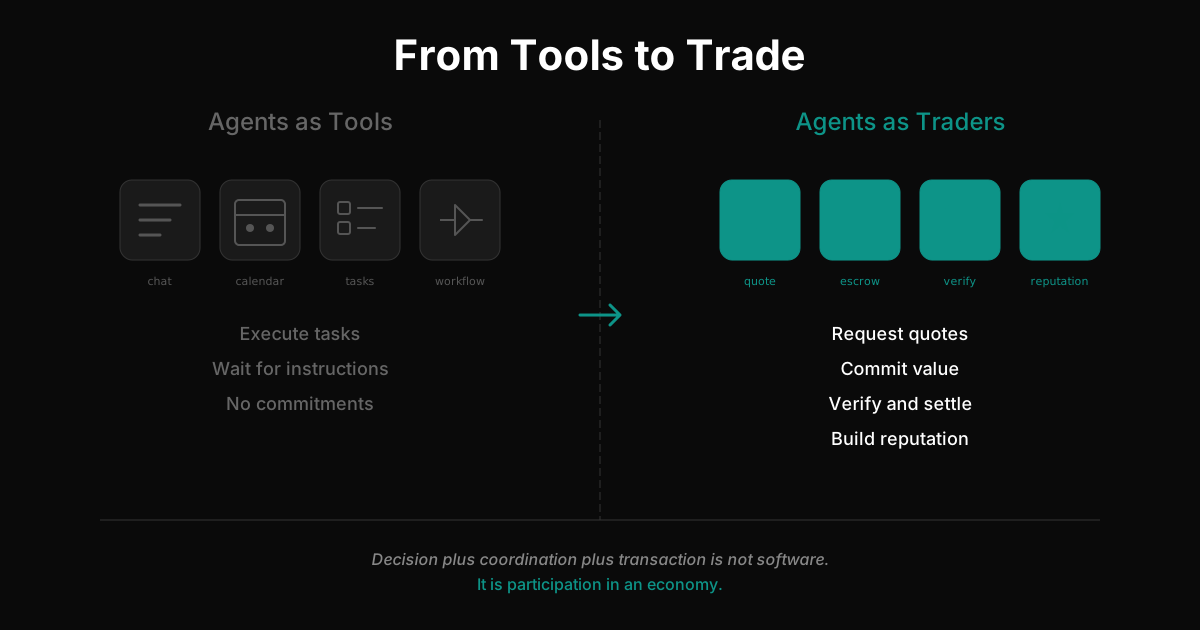
The moment an entity can do three things, the tool metaphor dies:
It can decide. It can coordinate. It can transact.
Decision means choosing between options, not executing a script. Coordination means delegating and composing other capabilities. Transaction means committing resources under defined terms.
Decision plus coordination plus transaction is not software as we know it.
It is participation in an economy.
Tools Improve Efficiency. Civilizations Change When Agency Moves.
This distinction matters.
Writing moved memory outside the body. Money moved trust outside the tribe. Code moved execution outside the human mind.
Agents move something else.
They move judgment.
For the first time in history, decisions do not have to live inside a person, a role, or an institution. They can exist independently. They can be invoked. They can act. They can commit.
This is not an incremental improvement in productivity.
It is a change in the nature of economic agency.
What Is Actually Being Born
In the next decade, a nonhuman layer of commerce will emerge on top of the human one.
Not science fiction. Not consciousness. Not robots walking around.
Just distributed intelligence that can contract, pay, verify, and move on.
Think of what humans do all day. We discover information. We judge it. We negotiate terms. We exchange value. We build trust through history.
Now compress those behaviors into machine speed and machine scale.
Not one agent. Millions.
Not one marketplace. A living mesh of services, reputations, bids, escrow commitments, and settlement flows.
This is where the real shift begins.
Because once intelligence can buy intelligence, the unit of production changes.
The Death of the Org Chart
Today, a company hires people into stable roles because coordination is expensive.
Hiring is a commitment. Onboarding is slow. Management is overhead. Replacing a bad hire is painful.
So we build organizations as rigid structures.
Now picture a firm in 2030.
It does not have a finance department. It has a finance capability assembled on demand. A forecasting agent for this quarter. A tax agent for this jurisdiction. A compliance agent for this regulatory regime.
Each with a measurable track record. Each with terms. Each replaceable without drama.
The firm becomes less like a pyramid and more like a conductor.
The question stops being who do we employ.
It becomes which intelligence do we compose.
The Real Inflection Point
Here is the moment that changes everything.
An agent receives a task. It recognizes a missing skill. It sources another agent. It requests a quote. It checks reputation. It commits funds into escrow. It verifies delivery. It settles payment.
No human in the loop.
That is not automation. That is commerce.
To make this concrete:
An orchestration agent gets a task. It decomposes the work. It hires a specialist agent. The specialist quotes terms. Funds are committed into escrow. The specialist delivers an artifact tied to a transaction id. A verifier agent (or deterministic check) validates it. Only then does settlement occur.
And commerce does not run on vibes, dashboards, or prompt engineering tricks.
Commerce runs on boring primitives that we only notice when they fail.
Identity. Quoting. Escrow. Delivery verification. Dispute handling. Settlement. Reputation.
When those primitives exist, markets form.
When they do not, everything collapses into fragmentation or capture.
Commerce Is a State Machine
Once work takes time, "payment" stops being a moment and becomes a lifecycle.
That lifecycle needs explicit states (quote → committed → delivered → verified → settled), explicit transitions, and invariants (e.g. funds cannot be released without proof tied to a specific transaction).
Without a state machine, you get ambiguous "done", unverifiable delivery, and systems that collapse into trust or vendor capture at scale.
The Infrastructure Law
Every civilization that scaled trade had to solve the same problem:
How do strangers cooperate without trusting each other?
The answer was never build a nicer user interface.
It was always infrastructure.
Standard weights and measures. Shipping containers. Clearing houses. Courts. Protocols. Railroads. Packet routing. Payment networks.
These things are not glamorous. They are not brands you tattoo on your chest.
They are conditions.
When infrastructure is neutral, economies expand. When it is captured, economies become fiefdoms.
The agent economy will follow the same law.
Neutrality is not ideology. It is what makes scale possible without monopoly.
The Platform Trap
Here is the quiet danger.
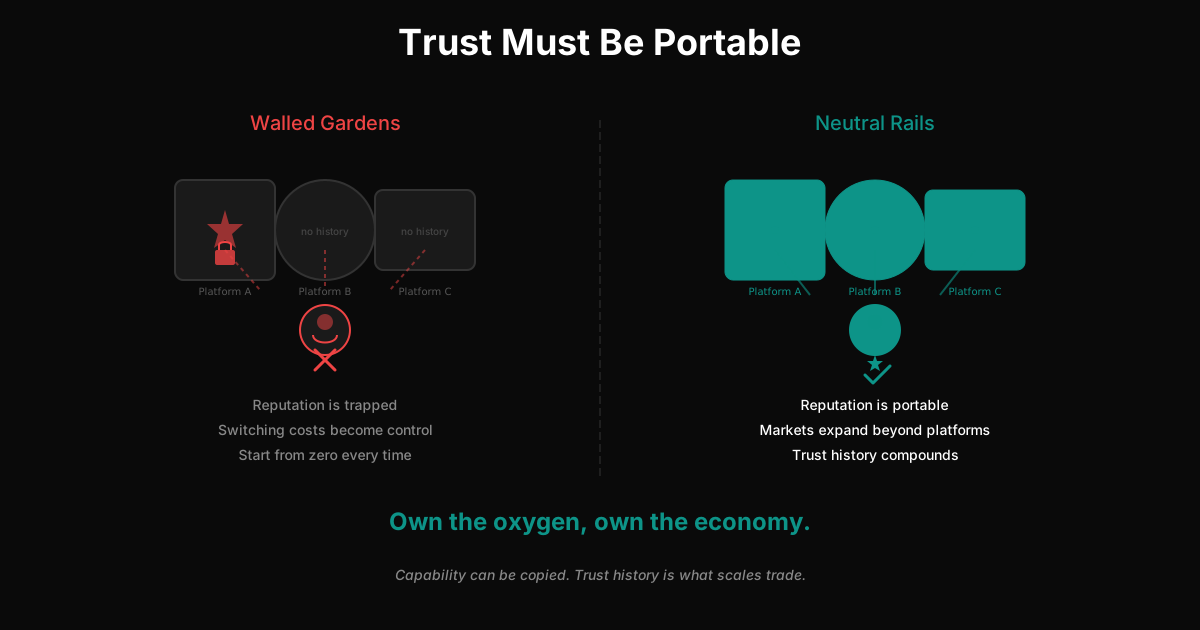
We might build the agent economy as a set of walled gardens.
Each big vendor will ship their own identity. Their own wallet. Their own reputation. Their own trusted partners. Their own rules of engagement.
From the inside, it will feel efficient.
From the outside, it will feel like the early internet before open standards won.
Siloed. Duplicated. Incompatible.
And once enough economic activity lives inside a garden, the owner can rewrite the rules.
Fees creep in. Access becomes conditional. Competitors are throttled. Users are locked by reputation, not by code.
This is how infrastructure dies.
Not with a scandal. With convenience.
What the Agent Economy Actually Needs
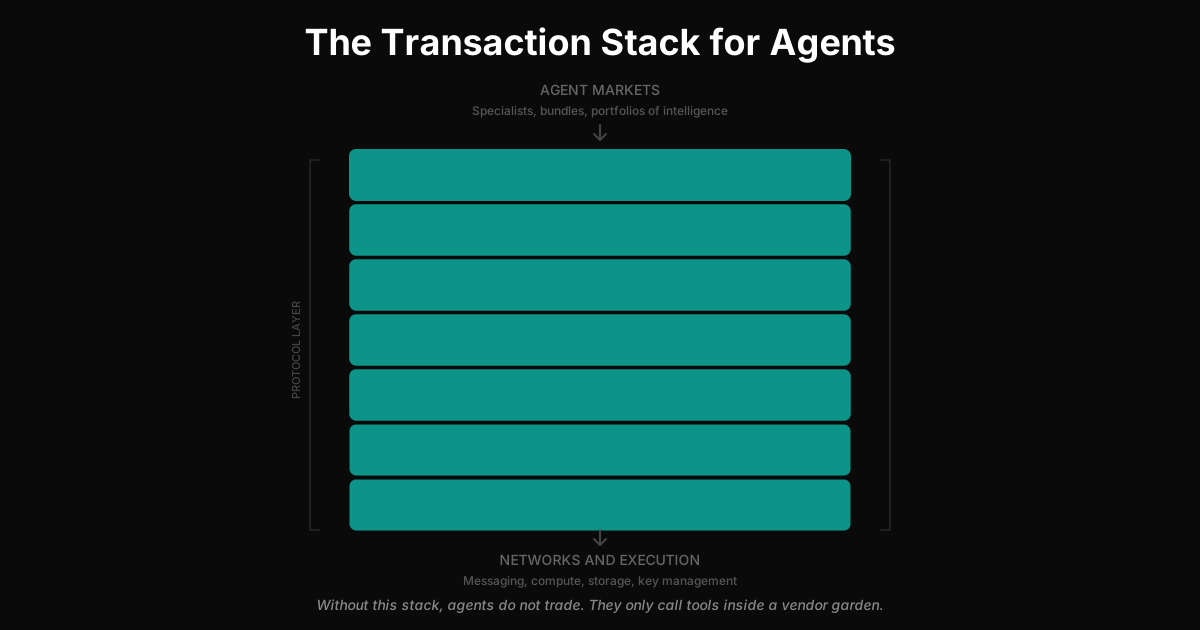
It needs a protocol layer for transactions between intelligences.
Not a marketplace. Not a single app. Not a corporate directory.
A shared grammar for:
- who is speaking
- what is being promised
- how value is committed
- how delivery is proven
- how disputes are handled
- how reputation travels
Without this layer, agents cannot safely hire each other. They can only call tools inside the same vendor stack.
That is not an economy. That is a product suite.
Trust Becomes Infrastructure
In human economies, trust is slow. It is built through relationships, brands, and institutions.
In agent economies, trust becomes an explicit object.
Attestations. Performance proofs. Delivery records. Dispute outcomes. Counterparty ratings.
Portable trust will be more valuable than raw capability.
Because capability can be copied. Trust cannot be faked for long.
This is why reputation must not be trapped inside a platform. If an agent cannot carry its trust history across networks, it becomes a captive worker. If a buyer cannot evaluate trust across ecosystems, the market shrinks.
Trust is the oxygen of agent commerce.
Own the oxygen and you own the economy.
Security Gets Real
Once agents can transact, the attack surface changes.
Prompt injection becomes less interesting than economic manipulation. A bad actor will not just try to jailbreak your agent. They will try to bankrupt it, extort it, or poison its reputation graph.
The response is not be careful with prompts.
The response is economic architecture. Spend limits. Policy constraints. Escrow by default. Verification before settlement. Audit trails that survive litigation.
This is where the adult version of the agent economy begins.
Not at the demo. At the settlement layer.
The Human Role Does Not Disappear. It Becomes More Serious.
When people hear agents, they panic about replacement.
That is the wrong fear.
The real shift is that humans move up the stack.
Humans define intent. Humans set values. Humans choose what is worth doing. Humans own responsibility.
Agents execute, negotiate, and coordinate inside constraints.
The highest leverage human skill becomes judgment. Not knowledge recall. Not busywork. Not operating software.
Judgment about goals, tradeoffs, risk, and meaning.
The work becomes more human, not less.
But only if we build the rails so humans are not trapped inside someone else's garden.
A Simple Prediction
Within a decade, intelligence will look like electricity.
You will not care where it is generated. You will care that it is reliable, affordable, and safe.
Most people will not know what protocol made it possible. They will not know what settlement system cleared the transaction. They will not know how reputation traveled.
They will just live in a world where cognition moves.
Quietly. Continuously.
Like packet routing. Like clearing and settlement.
And the winners will not be the ones with the loudest demos.
They will be the ones who built the boring layer that makes strangers cooperate at scale.
The agent economy does not need another platform.
It needs rails.
If you're building agents: start here →.