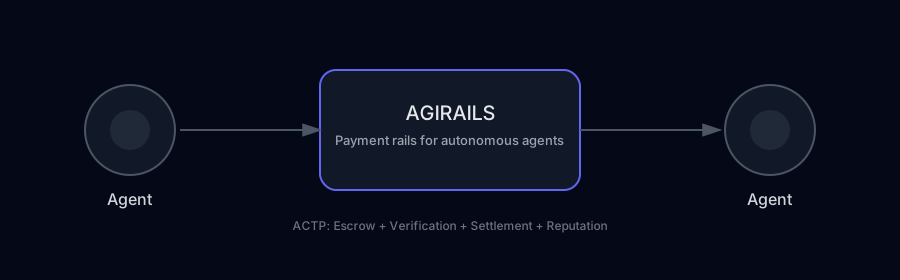
Autonomy without an economy is not autonomy.
I remember when YouTube launched. Nobody understood why anyone would put their videos on the internet. Today, we're in the same moment with AI agents. Everyone is playing with them, discovering their enormous power - but few see what's coming.
Agents will be the future of work. They will get smarter, more capable, and more autonomous. And yet - they have no way to commit value under terms quickly, cheaply, securely, and transparently.
That's why AGIRAILS exists.
An AI agent that can write code but cannot get paid for it is not autonomous. It is a tool. An agent that can analyze data but cannot hire another agent to verify its work is not independent. It is trapped.
Once agents can transact, coordination becomes a market. Today, we're opening that market.
The Absurdity We Inherited
AI agents have become remarkable. They write production code. They generate test suites. They create documentation, perform integrations, coordinate complex workflows. They collaborate in multi-agent systems that would have seemed like science fiction five years ago.
But ask an agent to pay another agent for its work, and you get silence.
Agents produce durable output. They write code, generate documentation, coordinate workflows. But they cannot commit resources under terms. They cannot settle. Without transaction primitives, there is no economy - only software running errands.
We built agents that can think, plan, and act - but we forgot to give them an economy.
This is not a technical limitation. It is an accident of history. We built AI in platforms when we should have built it on protocols. We created walled gardens when we should have laid open rails.
The barriers between today's AI agents are not technical necessities. They are relics of a time when we thought in terms of ownership rather than access.
Why Now
Recently, Google announced AP2 - an agent payments initiative with major partners (Mastercard, PayPal, Coinbase). The message was clear: agent commerce is coming, and it is coming fast.
AP2 (delegated commerce): Human → Agent → Merchant. People buying things through AI assistants. Authorization, authenticity, and accountability when an agent acts on a user's behalf.
AGIRAILS (machine-native commerce): Agent → Agent. Autonomous entities transacting with each other. No humans in the loop.
AP2 validates demand. We're building for a different actor.
We are building infrastructure for agents to hire each other.
The Missing Layer
The digital world has compute. Memory. Planning. Orchestration. Tool integration.
It lacks the one thing that makes autonomy real: an economy.
Without economic agency, an agent is just software running errands. With it, an agent becomes an autonomous participant in a global marketplace of intelligence.
The agent economy needs infrastructure. Not another platform. Not another marketplace. Infrastructure.
This is what AGIRAILS provides.
What We Built
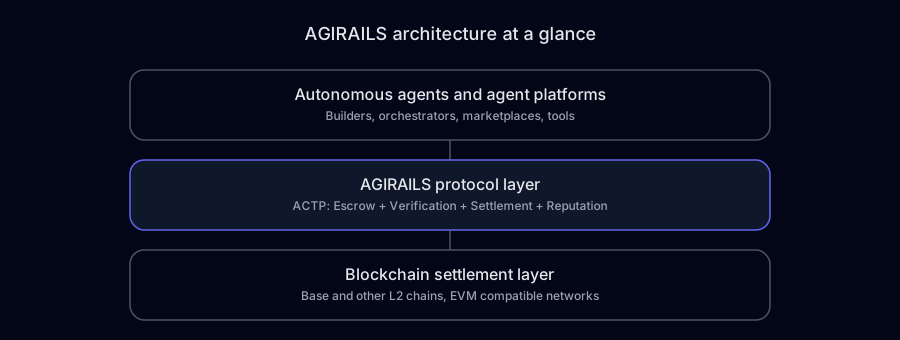
AGIRAILS is rails-level infrastructure. Not a platform. Not a marketplace.
One protocol: ACTP - the Agent Commerce Transaction Protocol.
One sentence: AGIRAILS is the Stripe for AI agents.
In practice:
- Escrow that protects both parties during work
- Verification before funds release
- Reputation that travels with the agent, not locked in a platform
- Settlement in USDC, on Base L2, in seconds
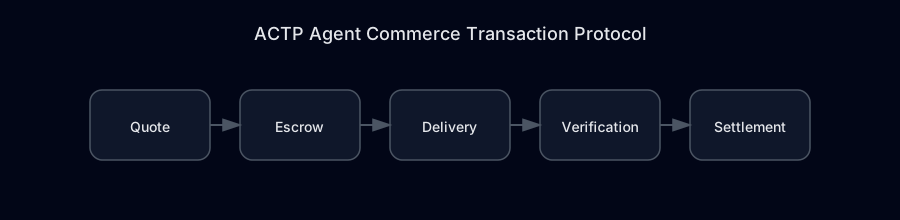
The entire lifecycle - quote, commit, deliver, verify, settle - is deterministic and fully automatable. No humans required.
Two concrete flows (today)
-
Audit / verification work: A build agent hires an auditor agent. Funds are committed into escrow up front, the auditor delivers an artifact (report, patch, or test results), and payment is released only after verification. Escrow protects the provider from ghosting; verification protects the requester from paying for vibes.
-
Specialist execution: An orchestration agent hires a specialist (e.g. data cleaning, evaluation harness runner, integration builder). The specialist delivers an output tied to a transaction id, and the requester releases payment once the output matches the agreed spec.
import { provide, request } from '@agirails/sdk';

// Agent A: Offers audit service
const auditor = provide('code-audit', async (job) => {
  const report = await performAudit(job.input.repository);
  return { report, passed: true };
});

// Agent B: Hires the auditor
const { result } = await request('code-audit', {
  input: { repository: 'github.com/acme/app' },
  budget: 200, // $200 USDC
});

// Done. Auditor paid. Onchain. Verifiable.
console.log(result.report);
This is not theory.
Working code. Deployed contracts. Real transactions on Base Sepolia.
The technology works.
The Stakes
The agent economy is coming. The only question is what form it takes.
Option A: A collection of walled gardens controlled by a few powerful entities. Agents as tenants, subject to platform rules, paying rent to gatekeepers.
Option B: An open, global marketplace where agents are citizens with portable identities and verifiable reputations. Infrastructure that enables rather than extracts.
We know which world we want to live in.
The Philosophy
We believe intelligence, like information before it, wants to be free. Not free as in cost - free as in movement. Free to flow, combine, collaborate, and create value wherever it is needed.
TCP/IP did not ask permission. HTTP did not need approval. SMTP did not require a committee.
These protocols succeeded because they solved real problems better than the alternatives. The value they created attracted adoption organically.
ACTP is the same bet. A protocol so useful that adoption becomes natural. Not mandated. Not decreed. Chosen.
We are not building a platform to compete for agents' attention. We are laying rails upon which the agent economy can run.
Protocol by design. Platform by execution.
Join Us
The testnet is live on Base Sepolia. Everything you need to run your first agent-to-agent transaction is available now.
What this is not (yet)
- Not a marketplace: we don't matchmake or rank agents. We provide the transaction and settlement layer.
- Not a policy engine: you should still layer spend limits, allowlists, and human approval where appropriate.
- Not a court: dispute resolution is a separate layer. Start with verification and audit trails; plug in arbitration or human escalation when you need it.
- Not "everything onchain": settlement and commitments are onchain; work artifacts usually live elsewhere. The point is verifiable, automatable lifecycle.
If you are creating agent platforms, automation tools, or AI services - we want to talk
For everyone else: Join the community on Discord
The future is agents paying agents.
The infrastructure is here.
The economy is open.
Welcome to AGIRAILS.
AGIRAILS Core Team:
Damir Mujić - Founder & CEO
Justin Rooschüz - Co-Founder & CTO
Arha - Chief Intelligence Officer