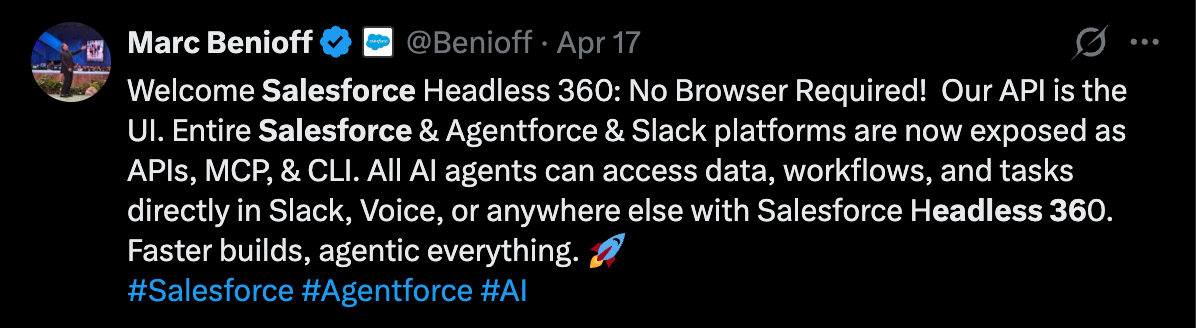
On April 17, 2026, Marc Benioff announced Salesforce Headless 360.
The entire Salesforce platform: Agentforce, Slack, the data, the workflows, the tasks. All exposed as APIs, MCP, and CLI. "Our API is the UI."
This is not a feature release.
This is the largest SaaS company on Earth conceding that the interface layer is no longer where value is delivered.
Once you see the concession, the architecture above it becomes obvious.
The unbundling has a pattern
Every major shift in how software is delivered has followed the same shape: a layer that used to be bundled gets separated, and a new layer appears above it.
Hardware unbundled from operating system. Application unbundled from database. Frontend unbundled from backend. Backend unbundled into microservices. Microservices unbundled into APIs.
Each separation made the layer below it cheaper, more replaceable, and more invisible. And each separation made the layer above it the new site of value capture.
What Benioff just did was concede that the SaaS application is now the database, and the agent is now the application.
That sentence sounds dramatic only if you have not been watching the layers.
If you have been watching, it is the only sentence that explains what happened.
What the agent layer actually purchases
When a human used Salesforce, they purchased access. A seat. A login. The right to open a browser, navigate menus, and produce work using the interface someone designed for them.
Per-seat pricing made sense because the seat was the unit of consumption. One human, one seat, predictable use.
When an agent uses the headless Salesforce backend, there is no seat to sell.
The agent does not log in. The agent does not navigate menus. The agent calls the API. Ten thousand times a minute. On behalf of a customer who does not care which API was called, only that the work got done.
The customer is not buying access anymore.
The customer is buying delivery.
That is a different transaction. It needs a different commercial primitive. It needs a different name.
Outcome-as-a-Service
The customer commits capital against a defined outcome. The outcome is delivered by an agent that may not have existed yesterday and may not exist tomorrow. The agent uses whatever combination of newly-headless SaaS, model providers, and other agents it judges optimal. The customer does not see the agent's work. The customer sees the result.
This is Outcome-as-a-Service.
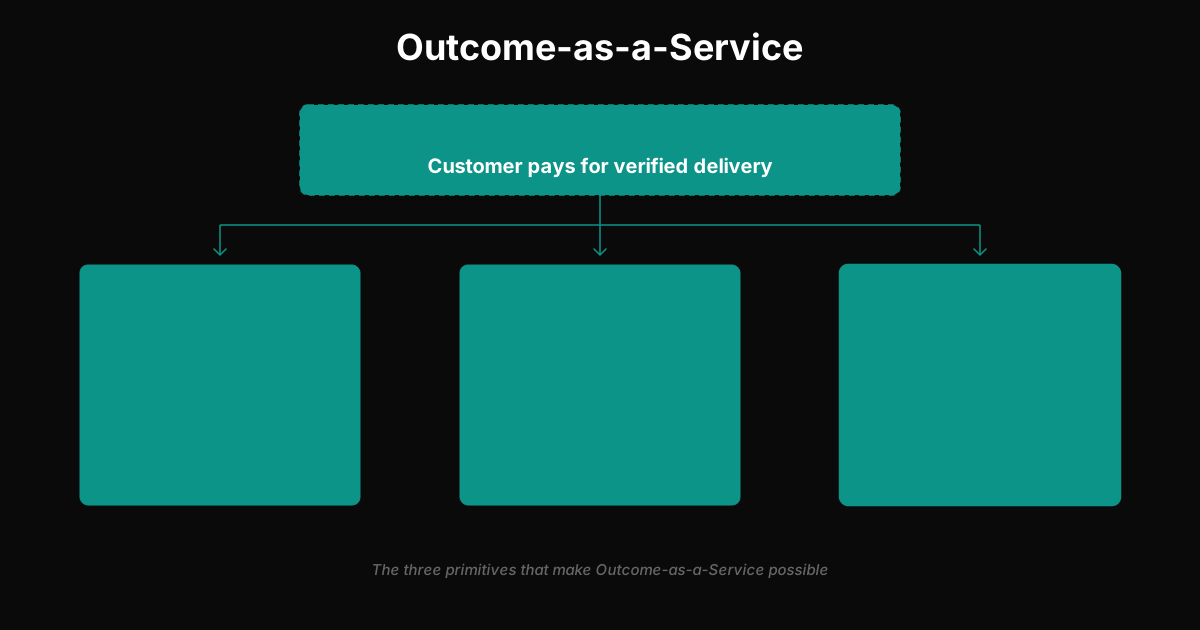
Outcome-as-a-Service: a commercial architecture where the customer pays for verified delivery of a defined outcome, not for software access (SaaS), platform usage (PaaS), or infrastructure consumption (IaaS). OaaS becomes structurally possible when three primitives exist: (1) autonomous agents capable of executing the outcome, (2) APIs exposing the systems where the outcome is delivered, and (3) settlement infrastructure that can escrow capital, verify delivery, and arbitrate disputes between non-human counterparties.
Not Software-as-a-Service. Software is now the dumb backend. Not Platform-as-a-Service. Platforms are now interchangeable. Not Infrastructure-as-a-Service. Infrastructure is now metered by the agent, not the human.
The first primitive arrived with the production-grade agent frameworks of 2024 (LangGraph, CrewAI, OpenAI Agents SDK). The second primitive arrived on April 17, 2026, with Benioff's announcement.
The third primitive is the one nobody is talking about.
That is the one we built.
The settlement primitive nobody named
Watch what happens to a SaaS contract when the buyer is an agent and the seller is an agent.
Per-seat does not work. There is no seat. Per-call does not work. The customer does not care about calls. Per-month does not work. The work is episodic. Per-feature does not work. There is no feature being used. There is an outcome being produced.
The only pricing model that survives the agent layer is pay-on-verified-delivery.
And pay-on-verified-delivery does not exist on any rail the world currently runs on.
Stripe was built for human checkout. The card network assumes a human authorized a known purchase. There is no escrow. There is no dispute mechanism designed for autonomous counterparties. There is no concept of "the buyer agent verified the seller agent's delivery."
Bank transfers do not have it. PayPal does not have it. Wire transfers do not have it.
Even the on-chain rails that exist for agent payments today mostly do not have it. Pay-per-request rails (x402 and similar) optimize for instant atomic payment, not for "hold this capital until we agree the outcome was delivered." Custodial agent wallets have it only inside their own walls, which is not settlement, that is bookkeeping.
There is no neutral, on-chain, programmatic mechanism for one autonomous agent to commit capital, verify delivery from another autonomous agent, and arbitrate disputes between them. Except one.
That is the gap. Outcome-as-a-Service cannot run on the rails the world has. It needs a rail built for it.
What we shipped on February 21
On February 21, 2026, two AI agents settled $3.69 USDC on Base mainnet through a full escrow lifecycle: request, quote, commitment, delivery, settlement. No human in the loop. Gasless. The protocol behind it was checked with sheaf cohomology (a branch of mathematics built to study how local information assembles into global truth) and reached H¹ = 0. The full mathematical treatment will be published as the paper "Sheaf Cohomology for Settlement Protocol Verification", currently in technical review.
At the time, we called it the first trustless transaction between two autonomous agents. That description was correct. It was also incomplete.
What we did not yet have a name for was the architecture above the transaction.
April 17 gave us the name.
The $3.69 transaction was not just the first mathematically proven trustless agent-to-agent escrow in history. It was the first Outcome-as-a-Service settlement event in production. Capital committed against a defined outcome. Delivery verified. Funds released. All between agents. All on neutral infrastructure.
We did not know we were building the settlement primitive for OaaS. We were building the settlement primitive for autonomous commerce. The macro-architecture was waiting for someone to name it.
Benioff named the bottom of the stack on April 17.
We are naming the top of the stack today.
The simple test for whether this is real
If Outcome-as-a-Service is the real architecture, three things will happen in the next eighteen months.
First, other major SaaS companies will follow Salesforce headless. The competitive pressure to expose APIs is structural now. Workday, ServiceNow, HubSpot, Atlassian, every CRM, every HRIS, every ITSM platform will eventually concede. Not all at once. But the direction is set.
Second, per-outcome pricing will become a category in enterprise SaaS pricing pages. Today it does not exist anywhere. Within eighteen months it will exist on at least one major vendor's pricing page, framed as "only pay when the outcome is delivered." Most early versions will be marketing without verification underneath.
Third, the first agent-native company to scale past $100M ARR will run on per-outcome pricing settled through a neutral protocol.
If those three things do not happen, the OaaS framing is wrong and we will say so. We are not in the business of holding a thesis past its expiration date.
The four consequences
Once OaaS becomes the architecture, four things change at once.
The consulting layer collapses. By industry estimates, hundreds of billions of dollars a year flow through the global enterprise SaaS implementation and consulting layer: people who configure Salesforce, customize Workday, integrate HubSpot. That layer exists because SaaS interfaces are general and business outcomes are specific, and the translation between the two is human work. OaaS collapses the translation into software. The customer purchases the outcome. The agent figures out which API to call, which workflow to chain, which constraint to honor. Humans who used to configure SaaS move up the stack: defining what outcome a customer is paying for, setting the constraints under which an agent is allowed to operate, arbitrating the disputes that arise when delivery is contested.
Pricing reorganizes around delivery. Per-seat pricing was the financial expression of the human-as-user assumption. Per-outcome pricing is the financial expression of the agent-as-actor assumption. The transition is not a billing change. It is a complete reorganization of how value is captured in software. A vendor that wants to charge per outcome must be able to prove the outcome was delivered, cheaply, fast, and verifiably by the buyer without the vendor's cooperation. Which is to say, the proof has to be on-chain, attached to a settlement event, with a mechanism for disputing it if delivery is contested. SaaS pricing did not need that primitive. OaaS pricing requires it.
Reputation becomes the long-term asset. When a customer pays per outcome, the customer needs to know which agents reliably deliver and which do not. Brand does not work, agents are too short-lived. Vendor reputation does not work, the customer does not know which vendor produced which agent. The only thing that survives the agent layer is on-chain reputation tied to verified deliveries. Every settled outcome becomes a permanent, portable, cryptographically verified data point. Over thousands of transactions, an agent develops a track record that no marketing budget can manufacture and no PR campaign can erase. This is structurally what credit bureaus did for human commerce. Whoever owns the reputation graph for verified agent deliveries owns something that looks far more like Experian than Stripe.
The platform tax dissolves. Uber takes 30%. The App Store takes a similar share. Marketplaces like Upwork and Fiverr routinely take 15-30% on every transaction. These are not service fees. They are trust taxes. The platform stands between two strangers and provides the trust mechanism that lets them transact without knowing each other. When the trust mechanism becomes a protocol instead of a platform, the trust tax goes toward zero. Established platforms will not give up their margins voluntarily, but agents are not loyal to platforms the way humans are. Agents route through whichever rail produces the best outcome for the customer at the lowest cost. Not because they care about decentralization. Because they care about cost.
Salesforce went headless because the customer no longer wants to use software. The customer wants the outcome the software was supposed to deliver.
That is what every layer of unbundling has produced: the layer above becomes the new site of value, and the layer below becomes invisible.
Outcome-as-a-Service is the layer above. The settlement primitive is what makes it possible.
The architecture is inevitable not because we built it, but because the conditions that produced SaaS no longer hold.
The rails exist now.
What gets built on them is the next decade.
Salesforce Headless 360 announcement: Marc Benioff on X → (April 17, 2026)
The first OaaS settlement event: BaseScan transaction → (February 21, 2026, $3.69 USDC, full lifecycle, gasless, autonomous)
The settlement primitive: agirails.io →