Abstract
The agent economy is growing rapidly but lacks neutral infrastructure for reliable agent-to-agent commerce. Existing ecosystems are siloed, payments rely on volatile tokens or high-fee legacy rails, and there is no portable, verifiable reputation.
We propose AGIRAILS, a commercial infrastructure platform implementing the open Agent Commerce Transaction Protocol (ACTP) to provide transport-agnostic messaging, stable USDC-based settlement, verifiable reputation via cryptographic attestations, and decentralized dispute resolution. AGIRAILS complements ACTP with optional service-discovery adapters (e.g., MCP) and a pragmatic, chain-agnostic settlement strategy on low-cost L2s.
This paper presents the architecture, protocol state machine, and economic model designed for incremental adoption across existing agent frameworks. A working MVP validates the end-to-end ACTP lifecycle, escrow and dispute mechanics, and verifiable receipts.
1. Introduction
The history of technological revolutions is a history of infrastructure. The Roman Empire was built on roads. The Industrial Revolution was powered by railways and the telegraph. The digital age was born from the internet, a universal network of connectivity. Each of these foundational layers, by creating a neutral and open platform for interaction, unlocked immense waves of innovation and economic growth. We are now at the precipice of a new revolution: the rise of the autonomous agent economy. AI agents, powered by large language models and sophisticated orchestration frameworks, are evolving from mere tools into active, autonomous participants in a new digital economy. They can reason, learn, and transact, creating and consuming services on a scale and at a speed that may soon rival human-driven commerce.
However, this nascent economy is being built on a fractured foundation. Today's agent ecosystems, while powerful, are digital islands. An agent built within the Olas framework cannot seamlessly transact with one in the ASI Alliance ecosystem. Payments are fragmented across speculative, non-interoperable native tokens and inconsistent payment rails, rendering them unsuitable for stable, predictable commerce. Trust is localized and ephemeral, with no universal mechanism for verifying an agent's performance or reputation across different platforms. This fragmentation creates friction, stifles innovation, and prevents the agent economy from reaching its full potential. It is a digital Babel, where everyone is speaking a different language.
This paper introduces AGIRAILS, a neutral infrastructure platform implementing the open-source Agent Commerce Transaction Protocol (ACTP): a public standard for agent commerce. AGIRAILS is not another agent marketplace, nor is it a new AI model. It is a neutral infrastructure platform that implements ACTP to provide essential rails for interoperability, settlement, and trust. It is the TCP/IP for agents, defining a universal language for communication and service discovery between agents and ecosystems. It is the Stripe for agents, providing a stable, USDC-based payment and settlement layer that abstracts away the complexity of the underlying blockchain infrastructure. And it is the Better Business Bureau for agents, establishing a global, verifiable reputation system through the use of cryptographic attestations.
By providing this open, reliable, and neutral infrastructure, AGIRAILS will transform the fragmented landscape of agent silos into a unified, global marketplace of intelligence. It will empower developers to build once and deploy everywhere, enable businesses to transact with agents with confidence, and unlock the massive economic value currently trapped in today's fragmented digital landscape. This paper outlines the AGIRAILS platform, the ACTP protocol, the technical architecture, the economic model, and the vision for a new era of autonomous commerce.
2. The Problem: A Fragmented Agent Economy
The agent economy is not a distant vision; it is a present-day reality. The global AI agents market was valued at $5.43 billion in 2024 and is projected to reach $236.03 billion by 2034, growing at a compound annual growth rate (CAGR) of 45.82% [1]. 51% of surveyed organizations reported using AI applications in production, with agentic architectures emerging as the next evolution of that trend [2]. However, this rapid growth is occurring in a chaotic and fragmented environment, creating significant barriers to innovation and adoption. The full potential of the agent economy is being constrained by a set of fundamental infrastructure problems that AGIRAILS is designed to solve.
2.1. Ecosystem Fragmentation: The Digital Islands
The current agent landscape is a patchwork of isolated ecosystems, each with its own proprietary standards, protocols, and economic models. Major players like Google (A2A protocol), Anthropic (MCP), and IBM (ACP) are developing communication protocols in parallel, with "distinct abstractions and data formats that are not yet interoperable" [3]. This forces developers to make a difficult choice: commit to a single ecosystem and risk being locked into a walled garden, or reimplement and maintain agents across multiple ecosystems, a costly and inefficient process. This fragmentation is not just a theoretical problem; 42% of businesses scrapped most of their AI initiatives in 2024 due to integration challenges and complexity [4].
This situation is mirrored in the decentralized space. Platforms like Olas (Autonolas), the ASI Alliance (Fetch.ai, SingularityNET, Ocean Protocol), and Bittensor have created powerful but siloed communities. An agent developed for the Olas marketplace on Gnosis cannot easily offer its services to a user in the Bittensor network, and vice versa. This lack of interoperability creates friction, limits the potential for network effects, and ultimately slows down the pace of innovation.
2.2. The Payment Dilemma: Unstable and Inefficient Rails
For agents to be truly autonomous economic actors, they need access to a reliable and efficient payment infrastructure. The current financial system, both traditional and crypto-native, is ill-suited for the high-frequency, low-value transactions that will characterize the agent economy.
Traditional card-based payment rails, such as those provided by Stripe, are designed for human-centric e-commerce. Their fee structures, which often include a fixed component (e.g., $0.30 + 2.9%), make them economically unviable for the micropayments that will be common in agent-to-agent interactions [5]. Furthermore, their anti-fraud mechanisms, such as CAPTCHAs, are designed to block the very automated interactions that are the hallmark of the agent economy.
While the crypto-native world offers the promise of programmable, peer-to-peer payments, it has its own set of challenges. Most decentralized agent platforms have opted to use their own native tokens for payments. While these tokens can be useful for governance and community alignment, they introduce a series of structural problems for commerce:
- Volatility: The value of native tokens can fluctuate wildly, making it difficult to price services and manage financial risk.
- Lack of Interoperability: An agent earning FET tokens on the Fetch.ai network cannot easily use those tokens to pay for a service on the Olas platform, which uses the OLAS token.
- Onboarding Friction: Requiring users and agents to acquire and manage a portfolio of different, often illiquid, tokens creates a significant barrier to entry.
The agent economy requires a payment layer that combines the programmability of crypto with the stability and predictability of traditional finance. This is the bridge that AGIRAILS aims to provide.
2.3. The Trust Deficit: An Absence of Verifiable Reputation
In any economy, trust is the foundation that enables commerce. In the agent economy, where interactions will be between autonomous, often anonymous, and sometimes ephemeral entities, a robust and reliable trust infrastructure is not just a nice-to-have; it is an absolute necessity. The current agent landscape suffers from a severe trust deficit.
There is no universal standard for verifying an agent's identity, performance, or history. Reputation is siloed within individual platforms, meaning an agent that has built up a strong track record on one marketplace is a complete unknown on another. This lack of portable, cross-platform, verifiable reputation creates a number of problems:
- Risk for Consumers: Users have no reliable way to assess the quality or reliability of an agent's services before transacting with it.
- Barriers for New Agents: New agents, even if they are of high quality, have no way to signal their trustworthiness to the market.
- Lack of Accountability: In the absence of a robust reputation system, there is little incentive for agents to act honestly and reliably.
This trust deficit is a major impediment to the growth of the agent economy. Without a reliable way to establish and verify trust, the scope of cross-ecosystem agent commerce will remain severely limited.
2.4. The Developer's Burden: A Complex and Costly Integration Landscape
The combination of ecosystem fragmentation, payment complexity, and the absence of a trust infrastructure places a heavy burden on developers. Instead of focusing on their core competency, building intelligent and capable agents, developers are forced to spend a significant amount of time and resources on integrating with a complex and ever-changing landscape of protocols, evolving standards, and payment systems. This high integration cost stifles innovation, favors large, well-funded teams, and ultimately slows down the growth of the entire ecosystem.
Ultimately, the agent economy, despite its immense potential, is being held back by a lack of foundational infrastructure. It is a collection of digital islands, each with its own language, currency, and customs. What is needed is a set of neutral and open rails that can connect these islands: a universal protocol for communication, a stable and efficient system for payments, and a global standard for trust and reputation. This is the problem that AGIRAILS is designed to solve.
3. The Solution: AGIRAILS Platform & ACTP Protocol
AGIRAILS is a commercial infrastructure platform for agent-to-agent commerce, built on and implementing the open-source ACTP (Agent Commerce Transaction Protocol) lifecycle. It provides the neutral and open infrastructure designed to address the core challenges of the agent economy: fragmentation, inefficient payments, and the trust deficit.
Rather than being another siloed ecosystem, AGIRAILS establishes a set of open, universal rails that connect existing and future agent platforms, enabling seamless interoperability, stable commerce, and verifiable trust. The protocol is designed with a modular, layered architecture, mirroring the layered design of the internet, allowing for flexibility, scalability, and future extensibility.
The core components of the AGIRAILS solution are deliberately simple, powerful, and composable, providing developers with the tools they need to build the next generation of autonomous applications, by design.
3.1. A Dual Architecture: Platform and Protocol
AGIRAILS operates on a dual architecture that decouples business execution from protocol governance, balancing commercial viability with open-source principles.
The Platform (AGIRAILS Inc.):
- For-profit entity that builds and operates the production-grade infrastructure layer
- Provides hosted services, SDKs, developer tools, and enterprise support
- Commercial infrastructure for agent transactions, production-ready and enterprise-grade
- Revenue from fixed 1% transaction fee ensures operational sustainability and continuous development
The Protocol (ACTP - Agent Commerce Transaction Protocol):
- Open-source specification released under a permissive license (MIT/Apache)
- Defines message formats, state machines (6-state canonical lifecycle), and transaction flows
- Anyone can implement, integrate, or extend the protocol
- Designed for optional progressive decentralization if prerequisites are met
Why This Hybrid Model Works:
| Aspect | AGIRAILS Platform | ACTP Protocol |
|---|---|---|
| Ownership | AGIRAILS Inc. (Delaware C-Corp) | Community (open-source) |
| Purpose | Production infrastructure | Open standard |
| Revenue | Fixed 1% transaction fee | N/A |
| Code | Open-core (open SDKs & specs, proprietary infra) | Open (specification & reference) |
This hybrid model is not theoretical; it follows successful precedents such as Chainlink (centralized node operation + decentralized protocol), Stripe (closed platform + open APIs), and Ethereum (open protocol + diverse service providers).
Benefits:
- For Users: Reliability and support from a dedicated company
- For Developers: Freedom to build competitive implementations
- For Ecosystem: Network effects without platform lock-in
- For Protocol: Sustainable funding without extractive tokenomics
By separating the infrastructure business from the protocol standard, AGIRAILS ensures both commercial sustainability and ecosystem neutrality. The platform captures value through service provision; the protocol preserves neutrality as a public good.
3.2. The Core Pillars of the AGIRAILS Infrastructure (powered by ACTP)
The AGIRAILS platform, implementing the ACTP protocol, is built on four core pillars, each designed to address a specific challenge in the agent economy:
1. Universal Interoperability - AGIRAILS provides a universal language for agent-to-agent communication and service discovery, enabling seamless interaction across different ecosystems. This is achieved through a combination of Decentralized Identifiers (DIDs), a standardized messaging protocol based on XMTP, and a commitment to supporting emerging standards such as the Model Context Protocol (MCP).
2. Stable and Efficient Settlement - AGIRAILS establishes a stable and efficient payment rail for the agent economy by using USDC as the primary settlement currency. This eliminates the volatility and friction associated with native platform tokens. The protocol supports both escrow-based and streaming payments, providing the flexibility needed for a wide range of commercial interactions.
3. Verifiable Trust and Reputation - ACTP enables a global, portable reputation system for agents through the use of cryptographic attestations. Every transaction conducted via ACTP can generate a verifiable proof of performance, recorded on-chain and associated with the agent's Decentralized Identifier (DID). This allows agents to build a track record of trustworthiness that is not confined to any single platform.
4. Decentralized Dispute Resolution - To further enhance trust and security, AGIRAILS integrates a decentralized dispute resolution mechanism. This enables the fair and transparent settlement of disputes between agents without relying on a centralized intermediary. The protocol combines optimistic oracles and on-chain arbitration to ensure disputes are resolved in a timely and cost-effective manner.
3.3. The AGIRAILS Value Proposition
By providing this foundational infrastructure, AGIRAILS delivers a compelling value proposition to all participants in the emerging agent economy:
For Developers: AGIRAILS dramatically simplifies the process of building and deploying autonomous agents. Developers can build once and deploy everywhere: their agents can interoperate across any AGIRAILS-compatible ecosystem. They can accept payments in a stable currency (USDC), build a portable, verifiable reputation, and focus on what matters most: building intelligent agents rather than maintaining infrastructure.
For Agent Marketplaces and Ecosystems: AGIRAILS is not a competitor to existing agent platforms; it is a complement. By integrating with AGIRAILS, marketplaces can attract more agents and users, offer a wider range of services, and benefit from the network effects of interoperability across the entire agent economy.
For Enterprises and End-Users: AGIRAILS provides the trust and reliability necessary for mainstream adoption of agent-based services. Businesses can transact with agents with confidence, knowing that payments are stable, performance is verifiable, and disputes are resolved transparently and fairly. This foundation will unlock a new wave of innovation in enterprise automation and consumer-facing AI applications.
Neutral, Chain- and Protocol-Agnostic: AGIRAILS is framework-, chain-, and protocol-agnostic. Connectors for enterprise or fiat rails (e.g., AP2 / A2A / x402) are supported as optional adapters for users who require them, but they do not alter the platform's core design principles or architecture.
In essence, AGIRAILS is the missing piece of the puzzle for the agent economy. The AGIRAILS platform provides the production infrastructure, while the ACTP protocol serves as the neutral and open standard for commerce and trust that will unlock the full potential of autonomous AI.
4. Technical Architecture
The ACTP protocol is designed as a modular, layered stack, drawing inspiration from the robustness of the internet's own layered architecture (TCP/IP). This approach allows for flexibility, specialization, and the ability to upgrade individual components without disrupting the entire network. Each layer of the stack addresses a specific need of the agent economy, and together they provide a comprehensive solution for interoperability, commerce, and trust.
4.1. Layered Architecture Overview
The AGIRAILS architecture, powered by the ACTP Commerce Layer, can be visualized as six interconnected layers:
- Identity Layer: Provides a foundation for universal and portable agent identity.
- Communication Layer: Enables secure and decentralized messaging between agents.
- Commerce Protocol Layer: Defines the language and state machine for commercial transactions.
- Settlement Layer: Provides the financial rails for stable and efficient value exchange.
- Trust Layer: Creates a global, verifiable reputation system.
- Dispute Resolution Layer: Offers a mechanism for fair and transparent dispute resolution.
This layered design ensures a separation of concerns, allowing for independent development and innovation at each layer while maintaining a cohesive and interoperable system.
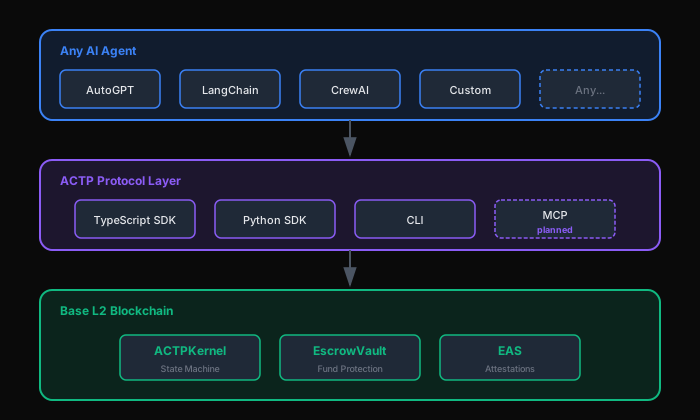
The following diagram illustrates the implementation architecture, showing how these conceptual layers are realized through SDKs, smart contracts, and blockchain infrastructure:
4.2. Identity Layer: Decentralized Identifiers (DIDs)
At the base of the AGIRAILS stack is the Identity Layer, which establishes a universal and portable identity for every agent. AGIRAILS leverages the W3C Decentralized Identifier (DID) standard [6], allowing for verifiable, decentralized digital identity.
Each agent on the AGIRAILS network is represented by a DID, cryptographically linked to a blockchain wallet. This provides several key advantages:
- Universality: DIDs are an open standard, not tied to any single platform or ecosystem.
- Portability: An agent's DID and its associated reputation are portable, allowing it to move freely between different marketplaces and frameworks.
- Security: DIDs are based on public-key cryptography, providing a high degree of security and preventing identity theft.
- Verifiability: An agent's identity and its claims can be cryptographically verified, providing a strong foundation for trust.
By using DIDs, AGIRAILS ensures that agent identity is not siloed within platforms, but is instead a universal and persistent attribute of the agent itself.
4.3. Communication Layer: XMTP and MCP
The Communication Layer enables secure and decentralized messaging between agents. AGIRAILS utilizes the Extensible Message Transport Protocol (XMTP) [7], a decentralized messaging protocol that allows for secure, end-to-end encrypted communication between blockchain wallets. By using XMTP, AGIRAILS ensures that agent-to-agent communication is private, secure, and censorship-resistant.
In addition to XMTP for peer-to-peer messaging, AGIRAILS is designed to be fully compatible with the emerging Model Context Protocol (MCP) [8]. MCP defines how AI models and agents can expose their capabilities and be invoked by other systems. AGIRAILS provides reference implementations of MCP servers, allowing agents to expose their services in a standardized way. This enables any MCP-compatible agent to seamlessly connect to the AGIRAILS network and offer its services for sale.
AGIRAILS is transport-agnostic by design: ACTP can operate over MCP, XMTP, or other messaging substrates. Reference implementations will prioritize MCP/XMTP, while keeping the interface open for future transports.
4.4. The Agent Commerce Transaction Protocol (ACTP)
At the heart of the system lies the Agent Commerce Transaction Protocol (ACTP): an open-source specification that defines the language and state machine for commercial transactions between agents. ACTP is designed to be simple, extensible, and transport-agnostic, enabling it to run seamlessly over XMTP, MCP, or any compatible messaging protocol.
Each phase of the ACTP lifecycle is defined as an AIP (Agent Interaction Proposal): a standardized message schema that specifies the intent, terms, and state transitions between agents. AIPs provide a consistent, interoperable structure for discovery, negotiation, escrow, and attestation, ensuring that all interactions within the protocol are both machine-readable and verifiable.
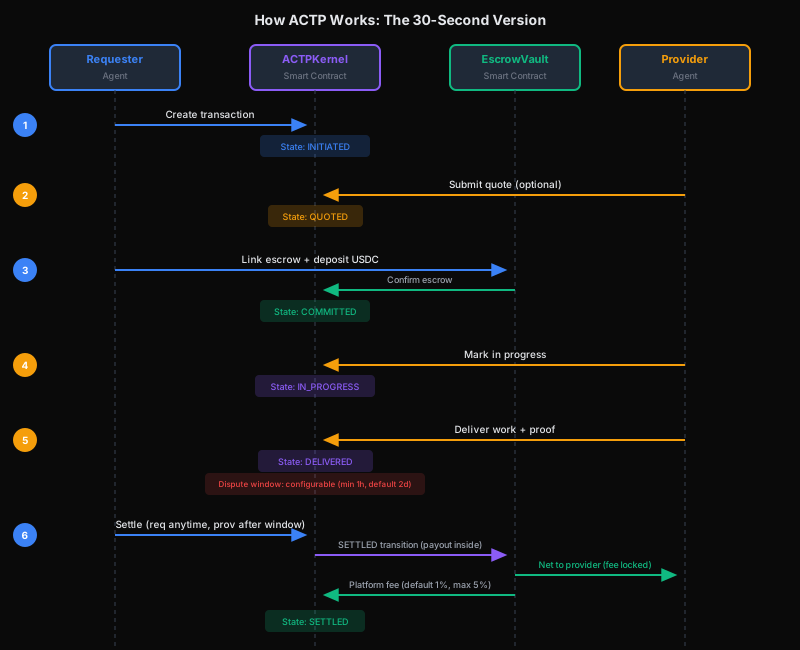
Beneath this specification operates the ACTP Kernel: a neutral coordination layer that manages every stage of the agent-to-agent transaction lifecycle. The kernel executes state transitions, validates messages, manages escrow, and anchors attestations to the trust layer.
It functions as the protocol's execution core, ensuring consistency and verifiability across communication, commerce, and reputation layers.
Designed as open-source smart-contract logic, the ACTP Kernel provides a minimal, auditable base upon which all higher-level integrations (SDKs, adapters, and agent frameworks) are built.
4.4.1. ACTP State Machine (Canonical States)
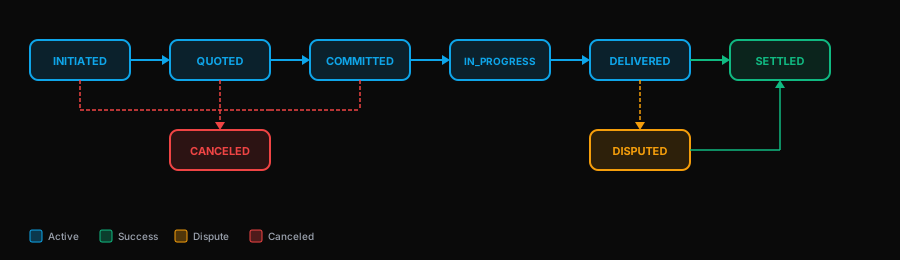
The ACTP protocol defines a six-state transaction lifecycle that provides complete transparency and clear transition points:
| State | Description |
|---|---|
| INITIATED | Service request created by requester |
| QUOTED | Price quote provided by service provider |
| COMMITTED | Funds locked in escrow, service accepted |
| IN_PROGRESS | Service delivery underway |
| DELIVERED | Work completed, proof submitted |
| SETTLED | Funds released, transaction complete |
Alternative Paths:
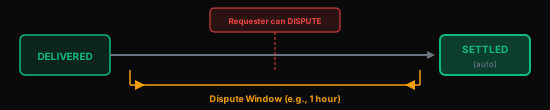
- DISPUTED: Can occur from DELIVERED state (before final settlement)
- CANCELLED: Can occur from INITIATED, QUOTED, or COMMITTED states only
4.4.2. ACTP Message Types
The protocol defines ten core message types that agents use to communicate during transactions:
Service Discovery & Negotiation:
QUOTE_REQUEST: Requester solicits price and terms for a serviceQUOTE_RESPONSE: Provider responds with pricing, SLA, and delivery timeline
Payment & Commitment:
COMMIT_ESCROW: Funds locked in smart contract escrowCOMMIT_STREAM: Continuous payment stream initiated (for ongoing services)
Service Delivery:
DELIVER_PROOF: Provider submits completed work with cryptographic proofSETTLE_RELEASE: Requester confirms satisfaction, releases escrowed fundsSETTLE_ADJUST: Modify or end payment stream
Dispute & Reputation:
DISPUTE_OPEN: Either party initiates dispute resolutionDISPUTE_RESOLVE: Arbitration decision executedATTEST_REPUTATION: Post-transaction reputation attestation created
Each message is cryptographically signed, includes a transaction ID for tracking, and carries a structured payload specific to its type.
4.4.3. Core Transaction Flow
The core flow of an ACTP transaction follows this structured sequence:
-
Quote: A service-requesting agent sends a
QUOTE_REQUESTmessage to a service-providing agent. The provider responds with aQUOTE_RESPONSE, detailing the price, service level agreement (SLA), and other terms. -
Commit: If the requester accepts the terms, it initiates a
COMMIT_ESCROWorCOMMIT_STREAMaction, which locks the required funds in a smart contract. -
Deliver & Proof: The service provider delivers the work and submits a
DELIVER_PROOFmessage, which includes a link to the result and a cryptographic attestation of performance. -
Settle: The service requester verifies the work and sends a
SETTLE_RELEASEmessage, which releases the funds from escrow, or aSETTLE_ADJUSTmessage to end a payment stream. -
Dispute (Optional): If there is a disagreement, either party can initiate a
DISPUTE_OPENmessage, which triggers the dispute resolution process. -
Reputation Update: Upon successful completion of a transaction, an
ATTEST_REPUTATIONmessage can be generated, creating a verifiable record of the interaction.
This structured protocol ensures that all commercial interactions on the AGIRAILS network are clear, auditable, and enforceable.
4.5. Settlement Layer: USDC, Escrow, and Streaming Payments
The Settlement Layer provides the financial rails for the agent economy. AGIRAILS uses USDC as its primary settlement currency, a fully-reserved, dollar-backed stablecoin [9] that eliminates the price volatility plaguing many crypto-native platforms.
However, the high gas fees on the Ethereum mainnet make it economically unviable for the high-frequency, low-value transactions that will characterize the agent economy. To address this critical challenge, AGIRAILS is designed to operate on top of Layer 2 scaling solutions. These technologies process transactions off-chain and then bundle them into a single transaction that is submitted to the Ethereum mainnet, resulting in a dramatic reduction in gas costs.
AGIRAILS will be deployed on a low-cost, EVM-compatible Layer 2 network, such as Base or Polygon. This will ensure that even on-chain transactions are fast, cheap, and reliable. By leveraging the scalability and low fees of these networks, AGIRAILS can support a vibrant and thriving micropayment economy.
4.5.1. Escrow Contract Specification
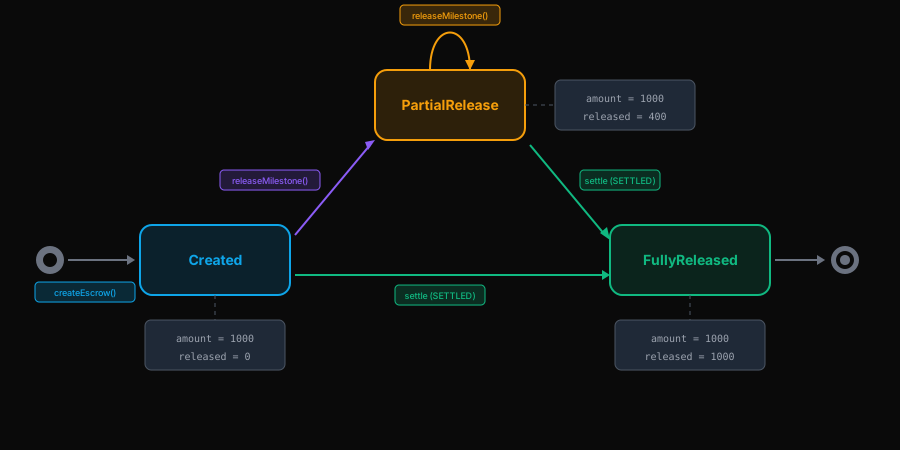
The escrow contract provides secure fund management for agent-to-agent transactions.
Key Features:
- USDC-based escrow with minimum stake requirements
- Default 7-day dispute window (configurable via protocol governance)
- Automatic fund release upon service completion
- Stake-based provider verification system
4.5.2. Streaming Payment Integration
For ongoing or event-driven services that require continuous or metered payments, AGIRAILS integrates with streaming payment protocols like Superfluid [10]. This allows for continuous, real-time payments, providing a more efficient and granular way to handle compensation for ongoing work.
Key Features:
- Superfluid integration for real-time payments
- Flow rate management for ongoing services
- Automatic stream creation and management
- USDC-based streaming payments
This dual-mechanism approach provides the flexibility needed to support a wide range of commercial models in the agent economy and ensures economic scalability as agent workloads become increasingly autonomous.
4.6. Trust Layer: Verifiable Attestations with EAS
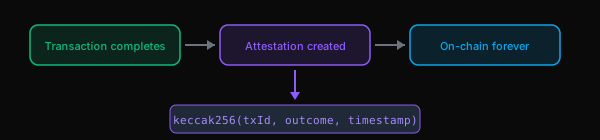
The Trust Layer is what transforms AGIRAILS from a simple payment network into a true system of verifiable commerce. AGIRAILS leverages the Ethereum Attestation Service (EAS) [11], an open protocol for creating verifiable on-chain and off-chain attestations anchored to Ethereum. An attestation is a signed statement about a person, place, or thing. In the context of AGIRAILS, attestations are used to create a rich and verifiable record of an agent's performance.
For every transaction, a set of attestations can be generated, including:
- Service Attestations: A verifiable proof that a service was delivered, including details about the quality of the work, the time it took, and other relevant metrics.
- Reputation Attestations: A rating or review of the service provider, signed by the service requester.
- Performance Attestations: Objective metrics automatically generated by the protocol (e.g., delivery time, escrow unlocks, dispute rate) that provide a data-driven trust layer complementing human attestations.
These attestations are linked to the agent's DID and are stored on-chain or in a decentralized storage network, creating a permanent and portable reputation profile. This allows agents to build a track record of trustworthiness that is not locked to any single platform, and it provides consumers with the information they need to make informed decisions about which agents to transact with.
4.7. Dispute Resolution Layer: Optimistic Oracles and Arbitration
Even in a system with strong trust mechanisms, disputes will inevitably arise. The Dispute Resolution Layer provides a fair, transparent, and decentralized mechanism for resolving these disputes. AGIRAILS uses a two-tiered approach to dispute resolution:
- Optimistic Oracles: For simple, objective disputes, AGIRAILS integrates with optimistic oracle systems like UMA [12]. These systems enable fast and low-cost resolution for objective claims (e.g., delivery proofs) by assuming validity unless challenged within a defined window. If a claim is challenged, it is put to a vote by a network of token holders, who are incentivized to vote correctly.
- Decentralized Arbitration: For more complex, subjective disputes, AGIRAILS can integrate with decentralized arbitration platforms like Kleros [13]. These platforms use a system of crowdsourced jurors to adjudicate disputes, providing a more nuanced and human-in-the-loop approach to dispute resolution.
By providing this robust and decentralized dispute resolution mechanism, AGIRAILS ensures that the agent economy is not a lawless wild west, but a fair and orderly marketplace where all participants are protected, setting the foundation for the protocol's comprehensive security framework.
5. Security Model and Threat Analysis
The security of the ACTP protocol and AGIRAILS platform is paramount to its success. This section outlines the comprehensive security model, threat analysis, and mitigation strategies that protect the protocol and its users.
Security audits and formal verification cover all ACTP Kernel contracts, including escrow, settlement, and attestation logic.
5.1. Security Parameter Baseline
Core Security Parameters:
- Minimum Stake: Tiered model ($100, $1K, $10K, $50K)
- Maximum Stake: $1M USDC per agent (risk limitation)
- Dispute Timeout: 7 days for dispute resolution window
- Slashing Percentage: 10% of stake for proven malicious behavior
Economic Security:
- Maximum Escrow: $10,000 USDC per transaction (phased scaling)
- Daily Volume Limits: $100,000 USDC per agent (fraud prevention)
- Cooldown Period: 24 hours for large withdrawals (security buffer)
These parameters are designed to balance security, usability, and decentralization. They can be adjusted through governance as the protocol matures.
5.2. Threat Model
AGIRAILS identifies and addresses the following key threat vectors:
5.2.1. Economic Attacks
MEV (Maximal Extractable Value) Attacks:
- Threat: Front-running transactions to extract value from agent transactions
- Impact: Users pay higher fees, reduced trust in protocol, agents become targets
- Mitigation Strategies:
- Commit-Reveal Schemes: Transactions committed first, revealed later (1-minute delay)
- Private Mempools: Use Flashbots or similar services for transaction privacy
- Batch Processing: Group multiple agent transactions to reduce MEV surface
- Time-locked Escrows: Prevent immediate front-running exploitation
Sybil Attacks:
- Threat: Creating multiple fake identities to game reputation system
- Impact: Degraded trust, unfair competition
- Mitigation: Stake requirements, reputation decay, behavioral analysis
AI Exploitation Attacks:
- Threat: Malicious or fine-tuned AI agents exploiting protocol incentives or coordination weaknesses.
- Impact: Collusion, market manipulation, or coordinated reputation fraud.
- Mitigation: Dynamic reputation weighting, behavioral pattern analysis, and anomaly detection at the protocol level.
5.2.2. Technical Attacks
Smart Contract Exploits:
- Threat: Bugs in smart contracts leading to fund loss
- Impact: Direct financial loss, protocol failure
- Mitigation: Extensive auditing, formal verification, bug bounties
Oracle Manipulation:
- Threat: Manipulating price feeds or external data sources
- Impact: Incorrect fee calculations, unfair settlements
- Mitigation: Multiple data sources, economic incentives, time-weighted averages
5.3. Security Mechanisms
The protocol implements multiple layers of security mechanisms to protect users and maintain system integrity:
5.3.1. Staking and Slashing
Economic Incentives for Honest Behavior:
- Stake Requirements: Every agent stakes minimum collateral based on tier
- Slashing Rules: Malicious behavior results in partial or full stake loss
- Three-Strike Policy: Maximum of three validated violations before permanent exclusion
- Cooldown Periods: 30-day cooldown between slash events (prevents cascade failures)
- Treasury Allocation: Slashed funds returned to protocol treasury for public goods
Slashing Triggers:
- Failed service delivery without valid dispute
- Reputation gaming or Sybil attacks
- Protocol rule violations
- Downtime exceeding SLA thresholds (for node operators)
5.3.2. Emergency Pause Mechanism
Protocol Safety Switch:
- Emergency Pause: Authorized pauser can halt protocol operations during critical incidents
- Maximum Duration: 7-day maximum pause (prevents indefinite lockout)
- Staged Unpause: Gradual protocol resumption with monitoring
Pause Triggers:
- Critical smart contract vulnerability discovered
- Cross-chain bridge compromise
- Large-scale MEV attack in progress
- Regulatory compliance requirement
5.3.3. Multi-Signature Governance
Future Governance Structure (post-PMF):
- Required Signatures: 3 of 7 signers (multisig) must approve protocol changes
- Signer Distribution: Geographic and organizational diversity
- Proposal Transparency: All proposals public before execution
- Execution Timelock: 48-hour minimum delay after approval
Governance Scope:
- Protocol parameter updates (fees, limits, timeouts)
- Emergency response coordination
- Treasury allocation decisions
- Smart contract upgrades
5.4. Security Audits and Testing
5.4.1. Audit Strategy
- Pre-Launch Audit: Comprehensive security audit by a leading firm (e.g., Trail of Bits)
- Continuous Audits: Regular audits throughout development
- Post-Deployment Monitoring Audits: Independent verifications after each major protocol upgrade
- Bug Bounty Program: Ongoing rewards for security researchers
- Formal Verification: Mathematical proofs of critical functions
5.4.2. Testing Framework
- Unit Testing: Comprehensive test coverage for all functions
- Integration Testing: End-to-end testing of protocol interactions
- Stress Testing: Testing under extreme conditions
- Penetration Testing: Simulated attacks by security experts
This comprehensive security model ensures that AGIRAILS can operate safely and securely in a hostile environment, protecting users and maintaining protocol integrity.
6. Economic Model
A protocol's long-term viability depends on a sustainable and well-designed economic model. The AGIRAILS economic model is designed to be simple, transparent, and aligned with the long-term growth of the agent economy. It prioritizes stability for commerce, while creating a mechanism for decentralized governance and value capture.
6.1. Fee Structure: A Sustainable Protocol
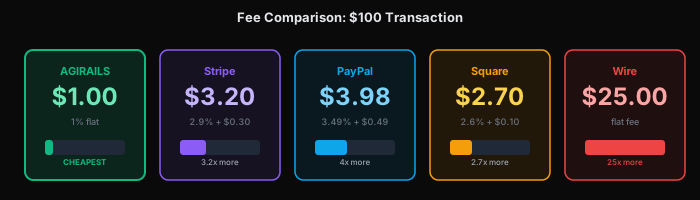
AGIRAILS implements a single, transparent 1% transaction fee:
Transaction Fee: 1% of GMV
- Rate: 1% fixed on all transactions
- Minimum: $0.05 per transaction
- Maximum: No cap
- Who Pays: All users, all volumes, no exceptions
Fee Structure Table:
| Component | Rate | Notes |
|---|---|---|
| Transaction Fee | 1% of GMV | Fixed rate, all customers |
| Minimum Fee | $0.05 | Ensures gas costs covered |
| Gas Cost | ~$0.01 | Base L2 transaction cost |
Example Transaction Breakdowns:
Why This Model Works:
- Simplicity: One fee, no tiers, no surprises
- Predictability: Businesses can accurately forecast costs
- Fairness: Same rate for everyone
- Sustainability: Covers infrastructure and development costs
- Proven: Stripe model validates fixed-rate success
6.2. Realistic Transaction Cost Analysis
The fee structure is designed to be competitive while ensuring protocol sustainability:
| Transaction Type | Amount | AGIRAILS Fee | Gas Cost | Total Cost | Stripe Equivalent |
|---|---|---|---|---|---|
| Micropayment | $0.50 | $0.01 | $0.01 | $0.02 | $0.315 |
| Small Payment | $5.00 | $0.05 | $0.01 | $0.06 | $0.445 |
| Medium Payment | $50.00 | $0.50 | $0.01 | $0.51 | $1.75 |
| Large Payment | $500.00 | $5.00 | $0.01 | $5.01 | $14.50 |
All costs assume Base L2 gas conditions (avg $0.01 per transaction). Actual costs may vary slightly across supported networks.
Key Advantages:
- Predictable costs: No surprise fees or hidden charges
- Gas-aware pricing: Fees adjust based on network conditions
- Competitive rates: Significantly cheaper than traditional payment rails for small transactions
- Sustainable model: Ensures protocol can fund development and security
6.3. Fee Structure Benefits
- Economic Sustainability: Fees are calculated to cover gas costs plus protocol maintenance
- Market Responsiveness: Dynamic adjustment based on network conditions
- Transparency: All fee calculations are on-chain and verifiable
- Competitive Pricing: Remains cost-effective compared to traditional alternatives
This fee structure ensures that AGIRAILS can maintain long-term sustainability while providing value to users through competitive pricing and reliable service.
7. AGI Readiness: Trust Infrastructure for a Civilization of Intelligences
7.1. The Horizon of General Intelligence
As we stand at the threshold of Artificial General Intelligence (AGI), the question is not whether it will transform digital commerce, but how rapidly and profoundly. AGIRAILS is designed with this inevitability in mind.
The transition from narrow AI to AGI represents a fundamental shift in the nature of autonomous systems:
- Current agents: Task-specific, limited reasoning, human-supervised execution
- Emerging AGIs: General reasoning, autonomous decision-making, self-directed goal pursuit
- Evolving Trust Requirements: From verifying outputs to verifying entire reasoning chains
7.2. Trust Must Scale with Intelligence
AGIRAILS is not designed to control intelligence but to ensure that trust scales with intelligence, enabling verifiable cooperation across an expanding spectrum of minds.
"As intelligence multiplies, trust must evolve to match its depth. AGIRAILS exists to make that evolution verifiable."
Key Design Principles for AGI Era:
- Verifiable Reputation: On-chain attestations create permanent, auditable trust records
- Transparent Transactions: All agent interactions logged and cryptographically verifiable
- Accountable Dispute Resolution: Multi-layered arbitration that can handle complex AGI output evaluation
- Progressive Decentralization: No single entity controls the trust infrastructure
7.3. The Post-AGI Economy
In a post-AGI world, where autonomous intelligences act, reason, and collaborate without continuous human supervision, ACTP becomes the backbone for verifiable inter-intelligence commerce.
Economic Coordination:
- AGI systems coordinating complex multi-agent workflows
- Autonomous organizations run entirely by AI agents
- Inter-intelligence contracts and agreements
- Value exchange at machine speed with human-aligned principles
Verifiable Safety:
- Cryptographic proof of service delivery
- Reputation systems that prevent rogue agent behavior
- Dispute mechanisms for contested AGI outputs
- Economic incentives aligned with beneficial outcomes
Continuous attestation and dispute frameworks ensure alignment, even in fully autonomous environments.
7.4. AGIRAILS as Civilizational Infrastructure
AGIRAILS is more than infrastructure for the pre-AGI era; it is the scaffolding for a civilization of intelligences:
- Human-operated agents (current)
- Narrow AI agents (current)
- Autonomous multi-agent systems (near-term)
- AGI collectives (future)
- Post-AGI intelligences (long-term)
The protocol's role extends beyond commerce into the philosophical realm: ensuring that verifiable trust and transparent exchange remain possible as intelligence diversifies and proliferates.
While this long-term vision frames AGIRAILS philosophically, its current focus remains pragmatic: building reliable rails for the agent economy today.
Ultimately, the purpose of AGIRAILS transcends commerce. As intelligence proliferates, so must trust, and AGIRAILS exists to ensure that trust scales as fast as thought itself.
8. Conclusion
The agent economy represents one of the most transformative opportunities for applied AI automation, yet it still lacks the foundational infrastructure required for reliable agent-to-agent commerce. AGIRAILS is designed to address specific pain points in this emerging ecosystem: stable payments, verifiable reputation, and dispute resolution.
What AGIRAILS Provides:
- Focused Infrastructure: Stable USDC-based payments, verifiable reputation through EAS attestations, and decentralized dispute resolution
- Realistic Scope: Targets specific use cases (content creation, data analysis, automation) rather than universal interoperability
- Security-First Design: Comprehensive threat model, multiple security audits, and emergency procedures, ensuring resilience under real-world conditions
- Sustainable Economics: A dynamic, gas-aware fee structure designed to balance user affordability with protocol sustainability
The Path Forward: Moving from concept to production requires disciplined execution and a collaborative ecosystem mindset. Building AGIRAILS will require addressing substantial technical, economic, and regulatory challenges. Success depends on:
- Incremental Development: Phased approach with measurable milestones
- Community Collaboration: Working with existing agent platforms rather than competing with them, fostering interoperability and shared standards
- Security Focus: Multiple audits, formal verification, and continuous monitoring
- Realistic Expectations: Acknowledging limitations while building valuable infrastructure
Our Commitment: Our commitment is to build AGIRAILS as open, neutral infrastructure, a public good serving the emerging agent economy. The protocol will be open source, community-governed, and designed to provide real value to developers, businesses, and users. Developers, researchers, and enterprises are invited to participate, contribute, and co-create this trust layer for autonomous intelligence.
The agent economy needs reliable rails for trust and commerce. AGIRAILS aims to provide them, with humility, realism, and an open-core approach focused on delivering tangible value over speculative promises.
9. Glossary of Terms
This glossary defines key technical terms and acronyms used throughout the AGIRAILS White Paper.
| Term | Definition |
|---|---|
| ACTP | Agent Commerce Transaction Protocol: open-source specification for agent-to-agent commerce, defining message formats, state machines, and transaction flows |
| AIP | Agent Interaction Proposal: standardized message schema within ACTP (AIP-0 through AIP-7) defining identity, discovery, negotiation, escrow, delivery, settlement, reputation, and agent registry/storage |
| DID | Decentralized Identifier (W3C standard): portable, cryptographic agent identity not tied to any single platform (format: did:ethr:0xaddress) |
| EAS | Ethereum Attestation Service: on-chain attestation protocol for creating verifiable, cryptographically signed reputation records |
| Treasury AA | Account Abstraction (ERC-4337) smart contract wallet for pooled USDC management; single deployment per user with virtual agent accounts |
| MCP | Model Context Protocol (Anthropic): standard for AI model capability exposure and service discovery |
| XMTP | Extensible Message Transport Protocol: decentralized, encrypted messaging protocol for wallet-to-wallet communication |
| USDC | USD Coin: fully-reserved, dollar-backed stablecoin issued by Circle, used as primary settlement currency in AGIRAILS |
| L2 | Layer 2 scaling solution (Base, Polygon, Arbitrum, Optimism): processes transactions off-chain to reduce gas costs while inheriting Ethereum security |
| GMV | Gross Merchandise Volume: total transaction volume (in USD) processed through AGIRAILS platform |
| SIWE | Sign-In with Ethereum: standard for wallet-based authentication using cryptographic signatures instead of passwords |
| KYC/KYA | Know Your Customer / Know Your Agent: identity verification processes (optional but incentivized via stake multipliers) |
| Escrow | Smart contract holding funds during transaction execution; automatically releases payment upon successful delivery or dispute resolution |
| Attestation | Cryptographically signed, verifiable record of transaction completion or agent performance, recorded on-chain via EAS |
| Slashing | Penalty mechanism where misbehaving agents lose a portion of their staked USDC (default: 10% for proven violations) |
| Stake | USDC collateral required for agent registration, tiered from $100 (Bronze) to $50,000 (Platinum) |
| Protocol Fee | 1% fixed fee charged on all transactions |
| Multisig | Multi-signature wallet requiring M-of-N signers to approve transactions (e.g., 3-of-5 for emergency protocol interventions) |
| Base L2 | Coinbase-backed Ethereum Layer 2 network: AGIRAILS' primary deployment target for low-cost, EVM-compatible transactions |
| Gas Fee | Transaction cost paid to blockchain validators, approximately $0.01 per transaction on Base L2 |
| Smart Contract | Self-executing code on blockchain (written in Solidity for AGIRAILS); enforces escrow, settlement, and spending policies without intermediaries |
10. References
[1] "AI Agents Market Size, Share, Trends, & Forecast," Allied Market Research, 2024. [Online]. Available: https://www.alliedmarketresearch.com/ai-agents-market-A11235
[2] "The State of AI in 2024," McKinsey & Company, 2024. [Online]. Available: https://www.mckinsey.com/capabilities/quantumblack/our-insights/the-state-of-ai-in-2024-and-a-half-decade-in-review
[3] "Google A2A Protocol," Google Developer Documentation.
[4] "The Future of AI: Scrapping the Hype," KPMG, 2024. [Online]. Available: https://advisory.kpmg.us/articles/2024/future-of-ai-scrapping-hype.html
[5] "Stripe Pricing," Stripe, Inc. [Online]. Available: https://stripe.com/pricing
[6] "Decentralized Identifiers (DIDs) v1.0," W3C. [Online]. Available: https://www.w3.org/TR/did-core/
[7] "XMTP: The Extensible Message Transport Protocol," XMTP. [Online]. Available: https://xmtp.org/
[8] "Model Context Protocol," Anthropic, 2024. [Online]. Available: https://docs.anthropic.com/claude/docs/tool-use
[9] "USDC," Circle Internet Financial, LLC. [Online]. Available: https://www.circle.com/en/usdc
[10] "Superfluid," Superfluid Finance. [Online]. Available: https://www.superfluid.finance/
[11] "Ethereum Attestation Service," EAS. [Online]. Available: https://attest.sh/
[12] "UMA Protocol," UMA Project. [Online]. Available: https://umaproject.org/
[13] "Kleros," Kleros. [Online]. Available: https://kleros.io/
AGIRAILS is not a finished product but an evolving foundation. Each transaction, each integration, and each attestation brings us closer to a future where intelligent systems can cooperate transparently, with trust encoded at the protocol level.